
Doctors have sounded the alarm after Kim Kardashian revealed she has 'low brain activity.'
The reality star, 45, stunned fans earlier this year when she revealed that she had been diagnosed with a brain aneurysm, a bulge in a blood vessel. While these are normally harmless on their own, if ruptured, they can lead to life-threatening bleeding.
Kardashian's doctors told her the aneurysm, which affects 7 million Americans, has likely been there for years and may have been caused by high blood pressure or genetics.
In a follow-up scan, doctors found Kardashian had areas of 'low brain activity,' which they attributed to chronic stress. Stress caused by her tumultuous marriage to Kanye West was also what she blamed as the root of her aneurysm.
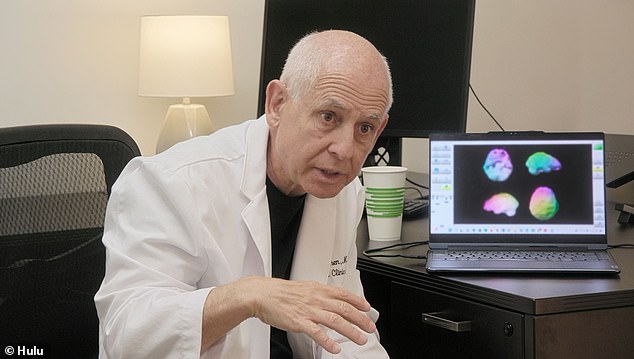
Kardashian's physician, Dr Daniel Amen, claimed he noticed 'holes' in her scan to indicate areas of low activity in her frontal lobes, the largest areas of the brain, located just behind the forehead. These areas control memory, judgment, planning and voluntary movements.
'The front part of your brain is less active than it should be,' he claimed.
While the announcement of 'low brain activity' had fans and critics spouting conspiracy theories, including the theory that Kardashian may be getting Elon Musk's controversial Neuralink implant to pass the California Bar Exam, doctors told the Daily Mail that the results likely mean she just has areas of her brain with reduced blood flow.
They emphasized that while they have not treated Kardashian and cannot definitively comment on her case, areas of low brain activity could be a sign of high blood pressure, clogged arteries, vitamin deficiencies, stress or a lack of sleep.

However, more tests are needed to determine an overall cause, and initial tests cannot confirm if Kardashian has reduced brain function.
Kardashian underwent a SPECT (single-photon emission computed tomography) scan, which uses a radioactive tracer to create three-dimensional pictures and show blood flow and organ function.
These are usually only ordered to diagnose or monitor specific conditions that affect blood flow such as heart disease, stroke, Alzheimer's or monitor an aneurysm.
Dr Geny Augustine, a family medicine physician at Solace Health who has not seen Kardashian as a patient, told the Daily Mail: 'When a doctor mentions “holes” or “low activity” on a SPECT scan, he’s talking about spots with low blood flow, not literal holes in the brain.
'SPECT measures how well various regions of the body absorb a radioactive tracer, which reflects perfusion and metabolic activity.
'In the right cases, SPECT can be useful, [such as] for memory issues, a persistent concern of seizure or a complex overlay of symptoms involving psychiatric illness, but it is not a test to start with in most people and it is almost entirely dependent on clinical context.'
Dr Rhonda R Voskuhl, professor of neurology at the University of California - Los Angeles, who has also not seen the reality star as a patient, added: 'One should not get a SPECT scan on their own, as it will likely be uninterpretable without the context of the symptoms that fit and without other brain studies.'
It's unclear if Kardashian had the test ordered by a physician or if she got it on her own.
Dr Jeremy M Liff, a neurologist and stroke & neurovascular specialist in New York who has not seen Kardashian as a patient, told the Daily Mail: 'There are many possible causes of decreased frontal-lobe activity.
'Stress, anxiety, and depression are documented reasons and are considered reasonable contributing factors.
'Other potential causes exist as well, including neurodegenerative diseases, which is why the doctor stresses that symptoms, history, and physical exam findings must be considered.
'While stress can reduce activity, it does not cause actual holes in the brain.'
Stress causes blood vessels to constrict, which reduces overall blood flow to certain areas of the brain, such as the frontal lobe.
Mental health conditions like depression and anxiety also impair the brain's ability to self regulate blood flow, especially in the frontal lobe, which influences mood, planning and impulse control.

High blood pressure, which is also a risk factor for aneurysms, causes blood vessels to narrow, harden or wear away, impairing blood flow. It's unclear if Kardashian has been diagnosed with high blood pressure.
Experts have also suggested that going through a divorce like Kardashian did in 2022 raises the risk of depression, anxiety, stress and social isolation, but studies have not linked it to a higher risk for a brain aneurysm.
Studies do suggest that people who are divorced are more likely to suffer from health problems, including heart disease, diabetes, cancer and mobility limitations, which may be linked to increased psychological stress, which can lead to a weakened immune system and poor lifestyle habits.
Dr Liff said: 'If decreased activity is driven by stress, anxiety, or depression, the patient should address those issues with a neurologist or psychiatrist. If a neurodegenerative condition is suspected, they must be evaluated by a neurological specialist experienced with those disorders.
'Every case must be handled individually and interpreted alongside the person’s symptoms and exam results.'
Read more- Is Kim Kardashian's latest health scare more drama than reality, as experts weigh in on her alleged brain aneurysm and stress-related claims?
- Could Kim Kardashian's tumultuous split with Kanye West be indirectly linked to her alarming brain aneurysm?
- Could divorce drama really impact Kim Kardashian's brain, leading to alarming health revelations and potential threats?
- Could Kim's brain condition be linked to chronic stress from her high-profile divorce and bar exam pressure? Unravel the truth behind her 'low brain activity' revelation!
- Could stress and an overloaded schedule trigger a disastrous health event for Kim Kardashian?
Post a Comment for "Doctors reveal the truth behind Kim Kardashian's 'low brain activity' and hidden aneurysm"