
“Competition in the obesity treatment market has intensified, and it is rapidly shifting from being centered on pharmaceutical companies to focusing on patients and consumers.”
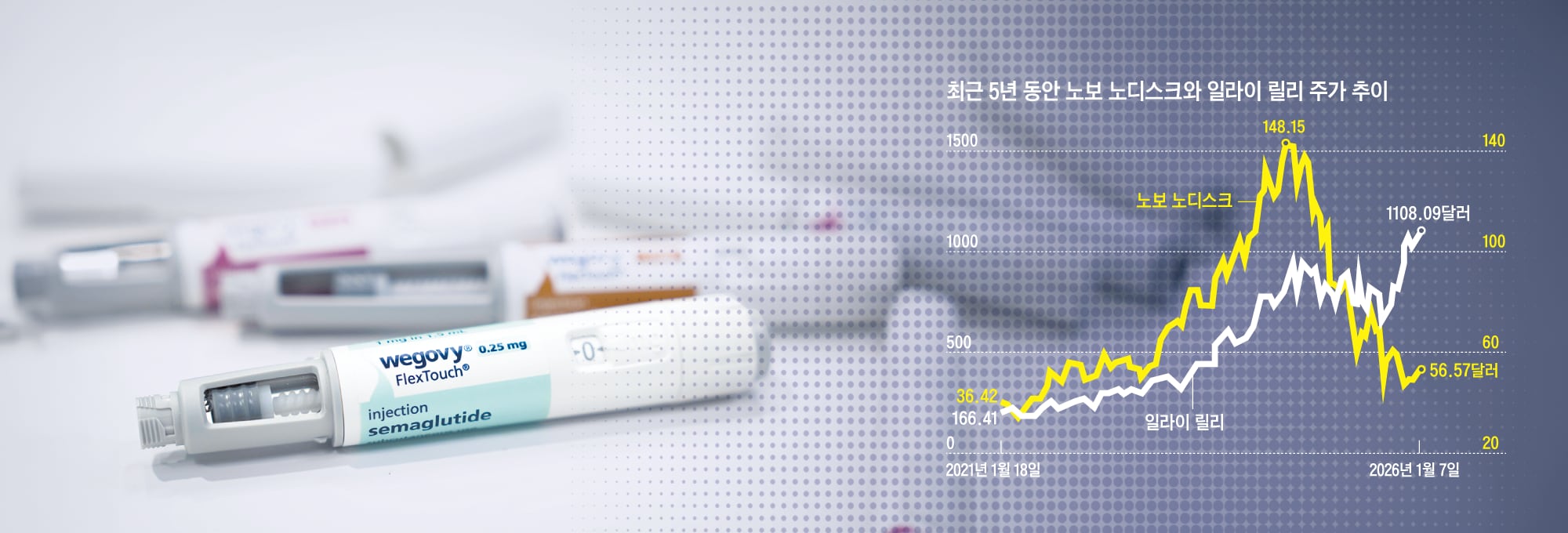
Mike Durstdar, the new CEO of Danish pharmaceutical company Novo Nordisk—best known for its obesity treatment ‘Wegovy’—made this statement in September of last year while announcing a large-scale restructuring plan, including layoffs of 9,000 global employees. This remark was interpreted as a reflection on the company’s failure to keep up with the rapid changes and explosive demand in the obesity treatment market. Novo Nordisk emerged as a leading player in the obesity treatment sector in 2021 when it first launched Wegovy in the U.S. market. Amid growing expectations, its stock price surged to US$148.15 per share in June 2024. However, the situation changed as supply shortages persisted. While failing to meet demand, some patients turned to generic or alternative treatments, and competitors accelerated their pursuit. Consequently, the stock price plummeted by over 60% within a year, now hovering around US$56.57 per share.
Novo Nordisk, which ranked first in the European stock market by market capitalization in 2023, began a major innovation drive last June with the appointment of a new CEO. The company is accelerating the development of next-generation obesity treatments while overhauling its business operations, including expanding direct-to-consumer sales channels. WEEKLY BIZ examined the strategies Novo Nordisk is preparing for its resurgence.
◇Leadership Change and Large-Scale Restructuring
Novo Nordisk led the obesity treatment market with the launch of ‘Wegovy,’ a GLP-1-based injectable treatment, in 2021. However, chronic supply issues due to insufficient production capacity, a marketing strategy that overlooked consumer accessibility, and inadequate response to market changes led to the loss of its leadership position to U.S. pharmaceutical company Eli Lilly.
As investor dissatisfaction grew, Novo Nordisk abruptly dismissed CEO Lars Fruergaard Jørgensen, who had led the company since 2017, in May of last year. Alongside the CEO change, the board underwent significant restructuring: seven board members stepped down, and former CEO Lars Levin Sørensen was appointed as the new board chairman.
In September of last year, the company announced a massive restructuring plan involving layoffs of 9,000 employees. Considering Novo Nordisk’s global workforce of 78,400, this represents approximately 11% of its total employees. Of these, 5,000 were based at the Danish headquarters, marking the largest layoff in Danish history.
The market cites “demand forecast failure” as Novo Nordisk’s biggest misstep. Durstdar CEO admitted, “Before launching Wegovy, the company expected demand to reach only three times that of its existing obesity treatment ‘Saxenda.’” Saxenda, approved by the U.S. FDA in 2014, was Novo Nordisk’s earlier obesity treatment. However, contrary to expectations, Wegovy’s demand exploded, reaching the equivalent of Saxenda’s four-year prescription volume within five weeks of its U.S. launch, and production capacity could not keep up.
In the meantime, Eli Lilly launched its obesity treatment ‘Zepbound’ in 2023 and began a full-scale pursuit. Eli Lilly rapidly increased supply through massive investments in manufacturing facilities, and as a result, surpassed Wegovy in new U.S. obesity treatment prescriptions by March 2024. While Wegovy struggled with supply shortages, the competitor flipped the script with production capacity and execution.
◇Improving Consumer-Friendly Sales Approach
Novo Nordisk, which has recently expanded its production capacity, has initiated large-scale improvements in its business operations. The key focus is on a sales approach that brings the company closer to consumers in the U.S. market. The company has clearly stated its intention to expand direct sales channels in the U.S., aiming to minimize intermediary distribution and allow patients to purchase medications through simpler pathways.
To this end, Novo Nordisk began selling Wegovy and Ozempic (a diabetes treatment) through pharmacies at retailers like Costco and Walmart. Dave Moore, Novo Nordisk’s U.S. Business Unit Head, stated, “The collaboration with Costco is a significant step for the company to enable consumers to purchase Wegovy and Ozempic at more reasonable prices through familiar shopping venues.” Durstdar CEO also emphasized the consumer perspective, saying, “We must meet the speed and flexibility expected by customers, like Amazon.” Novo Nordisk plans to sell the recently FDA-approved oral version of Wegovy to cash-paying patients on TrumpRx, a government-operated pharmaceutical sales site named after U.S. President Donald Trump.
Novo Nordisk has also adjusted its pricing structure. According to Reuters and other outlets, the company recently lowered the U.S. consumer prices for Wegovy and Ozempic from US$499 (approximately 720,000 Korean won) per month to US$349 (approximately 500,000 Korean won). Additionally, a promotion allowing new buyers to try the lowest-dose product for the first two months at US$199 per month is ongoing until the end of March this year. Furthermore, in November of last year, Novo Nordisk and Eli Lilly signed an agreement with the Trump administration to supply obesity treatments to Medicare at prices approximately 30% cheaper than private insurance claims. This measure marked the first inclusion of obesity treatments in Medicare coverage, significantly improving accessibility for elderly patients.
◇Launching Oral and High-Dose New Products
As Eli Lilly solidified its dominance by becoming the first pharmaceutical company to surpass US$1 trillion in market capitalization, Novo Nordisk is focusing on launching oral and high-dose obesity treatments to reclaim the market. The company recently received FDA approval for a once-daily Wegovy tablet (semaglutide 25 mg) and launched it nationwide in the U.S. on the 5th. Clinical trials showed this treatment achieved better weight loss results than Eli Lilly’s oral drug ‘orforglipron,’ which is under development.
Another key weapon is a high-dose (7.2 mg) Wegovy injectable, which is three times the current dosage. This product also demonstrated weight loss effects comparable to Zepbound in clinical trials. Novo Nordisk aims to dispel market concerns about its treatments being less effective than competitors by promoting these two highly effective products. The company has also secured sufficient production capacity for both.
Novo Nordisk is actively pursuing corporate acquisitions to strengthen its pipeline. While previously relying on in-house research for new drug development, the company is now broadening its strategy to absorb external technologies to accelerate growth. Additionally, as research suggests obesity treatments may improve kidney and liver conditions, the potential for expanded applications is another factor driving acquisitions. For instance, in November of last year, Novo Nordisk competed with Pfizer to acquire obesity treatment startup Metsera. Although Metsera ultimately partnered with Pfizer, Durstdar CEO is expected to continue focusing on diversifying the obesity treatment portfolio.
Post a Comment for "Novo Nordisk aims to approach consumers like Amazon"