
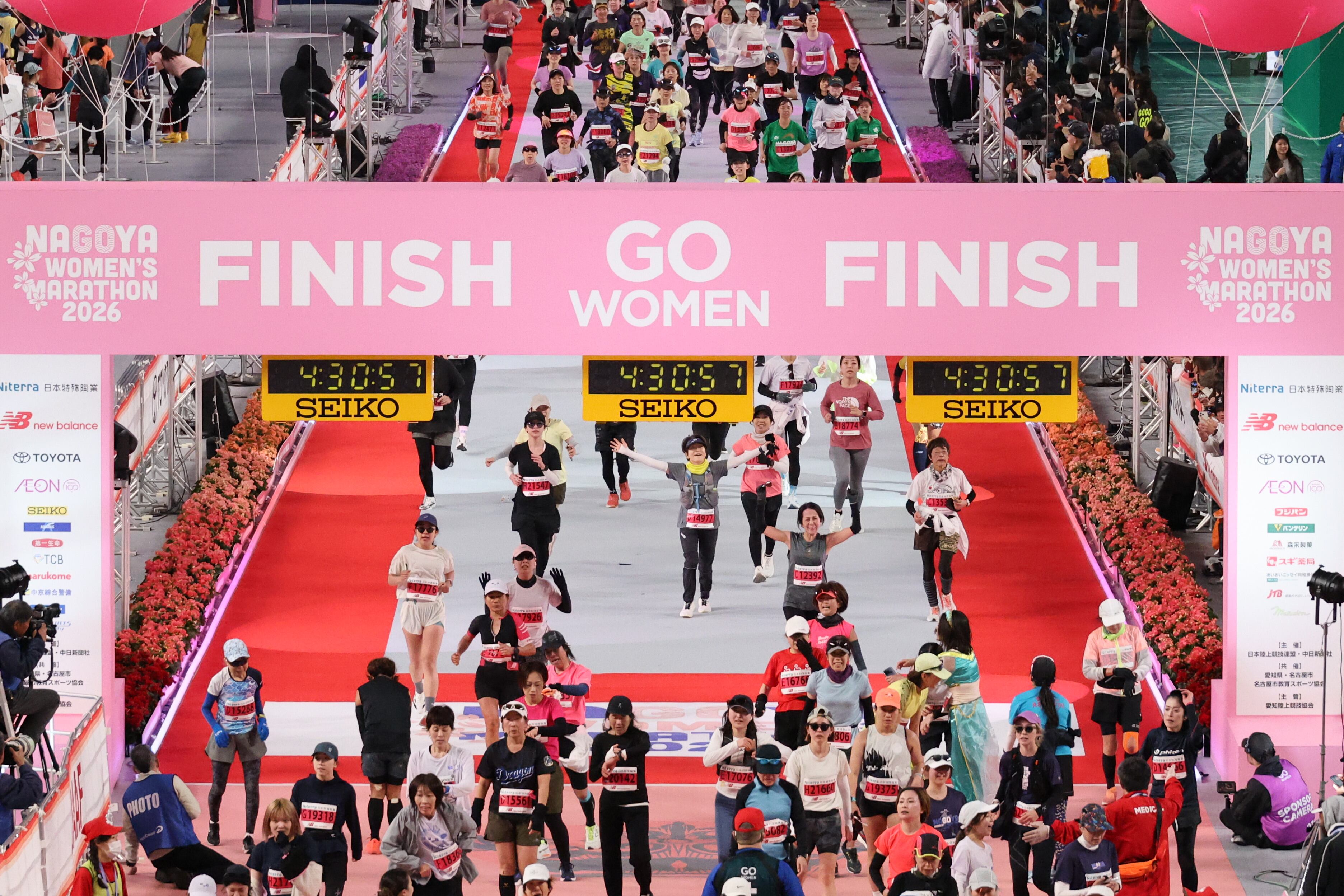
They say that in a marathon of 42.195 km, 30 km is run on leg muscles, 10 km on the heart, 2 km on the head, and the final 0.195 km on tears. I thought this old adage might be wrong. On the 8th, while running against the wind in Nagoya, Japan, up to 34 km, I had already exhausted not only my legs, heart, and head but also my tears. What drove the person who had nothing left to the finish line was the constant cheering, fellow runners who never gave up until the end, and the time I had spent overcoming myself throughout the winter.
Last spring, I completed my first half marathon. Gradually, I developed a desire to run a full-course marathon. However, during the autumn, known as the ‘marathon season,’ I suffered a fracture and could not participate in any competitions. In mid-November of last year, after removing my cast, I looked for the first available race I could run. Due to the running boom, most domestic competitions had already closed registrations by the first half of this year. I expanded my search to nearby Japan. The term ‘run trip’ (a trip combined with running) had already become a proper noun, with many people participating in overseas marathons. Although the registration deadline had passed, I found a competition that accepted additional applications: the 2026 Nagoya Women’s Marathon. It is a qualifying event for selecting Japan’s representative female athletes for competitions such as the World Athletics Championships and is recognized by the Guinness World Records as the world’s largest women’s marathon. This year, 17,101 participants, including elite athletes, took part, with approximately 3,500 being foreigners.
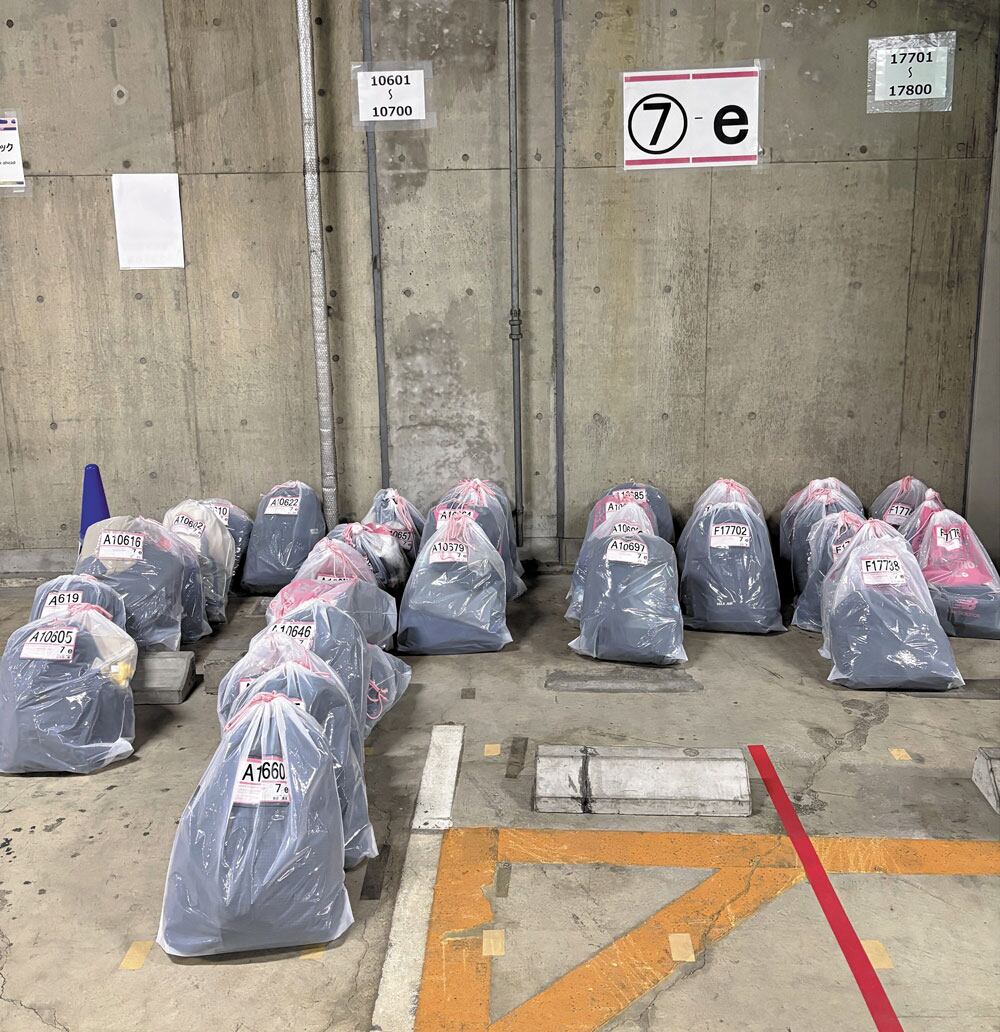
On the day of the competition, considering two factors, I arrived at the venue about 1 hour and 40 minutes before the start time. The issues were luggage storage and restrooms. Before standing at the starting line, it is common to leave outerwear and wallets at the luggage storage. With approximately 17,000 runners expected to gather at once, I thought the crowds would be chaotic. My prediction was completely wrong. The process ended in less than a minute. The luggage storage time was pre-assigned to groups A–F, and each group A was further divided into units of 100 people, preventing any bottlenecks.
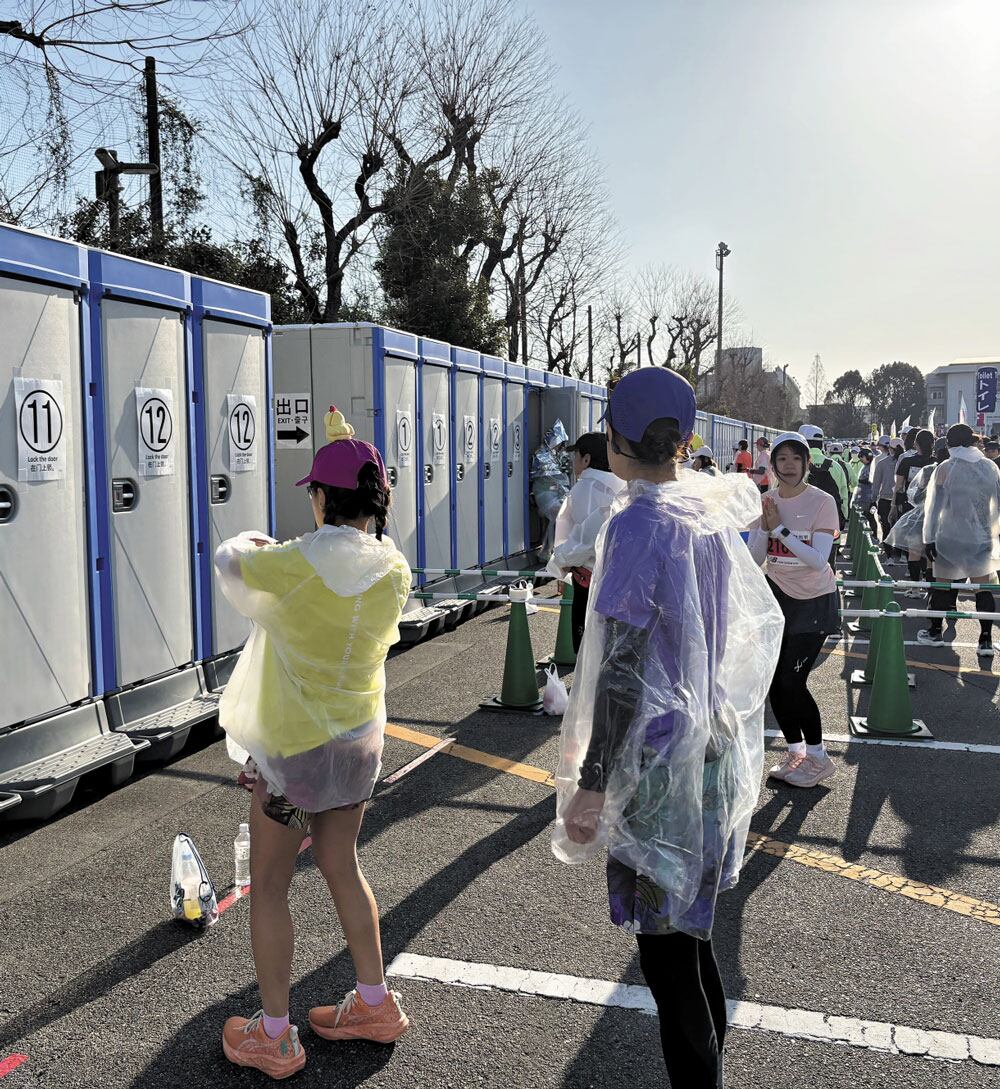
A total of 384 portable toilets were installed in a row at the starting point. Dozens of volunteers stationed there quickly directed people to shorter lines, much like immigration officers at an airport. My turn came in less than five minutes. With over an hour of free time, I leisurely observed the surroundings. Runners were seen consuming simple carbohydrates like bread or bananas or drinking energy drinks before the start. However, there was not a single piece of litter on the ground. Trash was either disposed of in bins placed throughout the area or held until volunteers with trash bags collected it.
The Nagoya Marathon course starts and finishes at the Vantelin Dome. As I stood at the starting line, a crowd of supporters filled the area around the course, shouting ‘Itterashai’ (have a good trip). The cheering made the first 5 km pass in an instant. The temperature that day was around 9°C, with winds of up to 6.6 m/s, making it a day with strong headwinds. Many runners wore raincoats to maintain body temperature even after the start. For about 1 km after the start, volunteers continued to distribute these disposable raincoats.
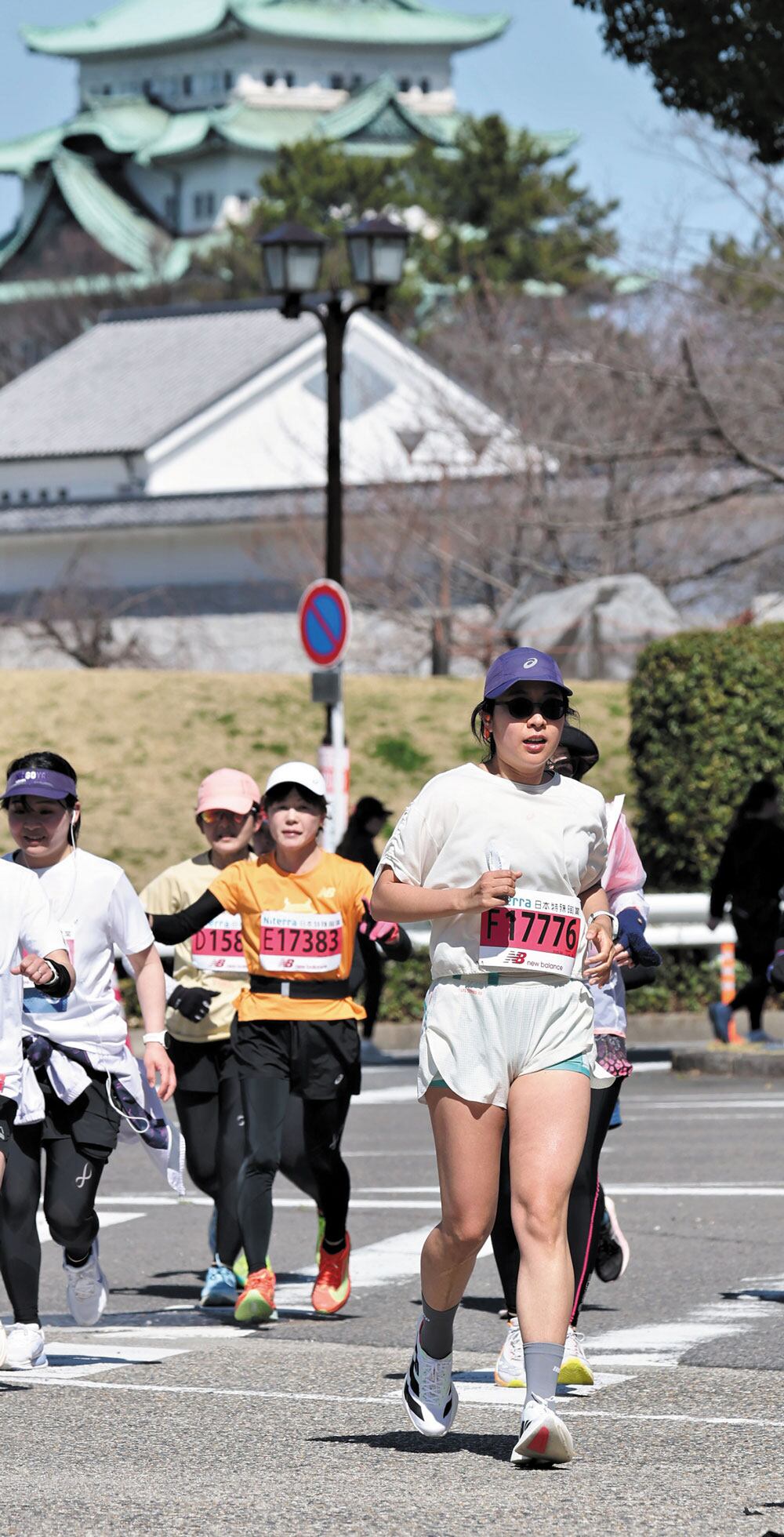
The surprise regarding trash continued throughout the run. In long-distance running, energy gels are typically consumed every 30–40 minutes to prevent energy depletion. In previous domestic competitions, specific sections would be littered with empty energy gel packets, allowing runners to immediately recognize ‘this is the gel-eating section.’ This did not happen here. Although there were sufficiently large and numerous trash bins for disposing of waste while running, the participants themselves seemed to believe that ‘running is not an excuse to litter.’ The clean and considerate course exuded dignity and courtesy.
Despite the mix of age groups from teens to those in their 70s, it was rare to see anyone walking until passing the 20 km mark. I felt that this competition featured many seasoned runners who had prepared thoroughly, not just participating on a whim. While there were few who sprinted ahead, everyone maintained their pace steadily. It reaffirmed Japan’s status as a marathon powerhouse.
A total of 15 aid stations, spaced every 2.5 km, provided water and sports drinks. The stations were sufficiently long, and signs indicating which station it was (e.g., ‘1/5’) prevented runners from clustering at once. After the 22.5 km mark, where runners typically deplete their stored energy, snacks such as rice cakes, red bean bread, chocolate, and kishimen (a Nagoya specialty noodle) were placed every 5 km along the course.
The citizens’ sincere cheering was unparalleled. According to the organizers, 250,000 citizens came to cheer along the marathon course that day. There was not a single section without cheering. After passing the 40 km mark and catching sight of the Vantelin Dome again, many citizens shouted ‘Okaeri’ (welcome back).
My preparation for the full course followed a running YouTuber’s ‘Miracle 100 Days’ program, starting 100 days before the competition. It claimed that following this program for 100 days would allow completing the full course within 4 hours. However, as someone with naturally slow speed and a working mom constantly short on time, it was far from easy. I had to return home before preparing my child for school and work during the day, so I never ran when the sun was up on weekdays. Still, except for one rest day per week to prevent injury, I wore my running shoes for 26 days a month. I ran even when it rained, snowed, on Christmas, and when the felt temperature dropped to -20°C. Adding up the distance run over 100 days, it totaled approximately 700 km. Typically, amateur runners need to accumulate over 300 km per month to build the stamina and muscle to stably run a full course. My monthly average was slightly over 200 km, so it could not be called perfect preparation. However, it was a preparation without regrets.
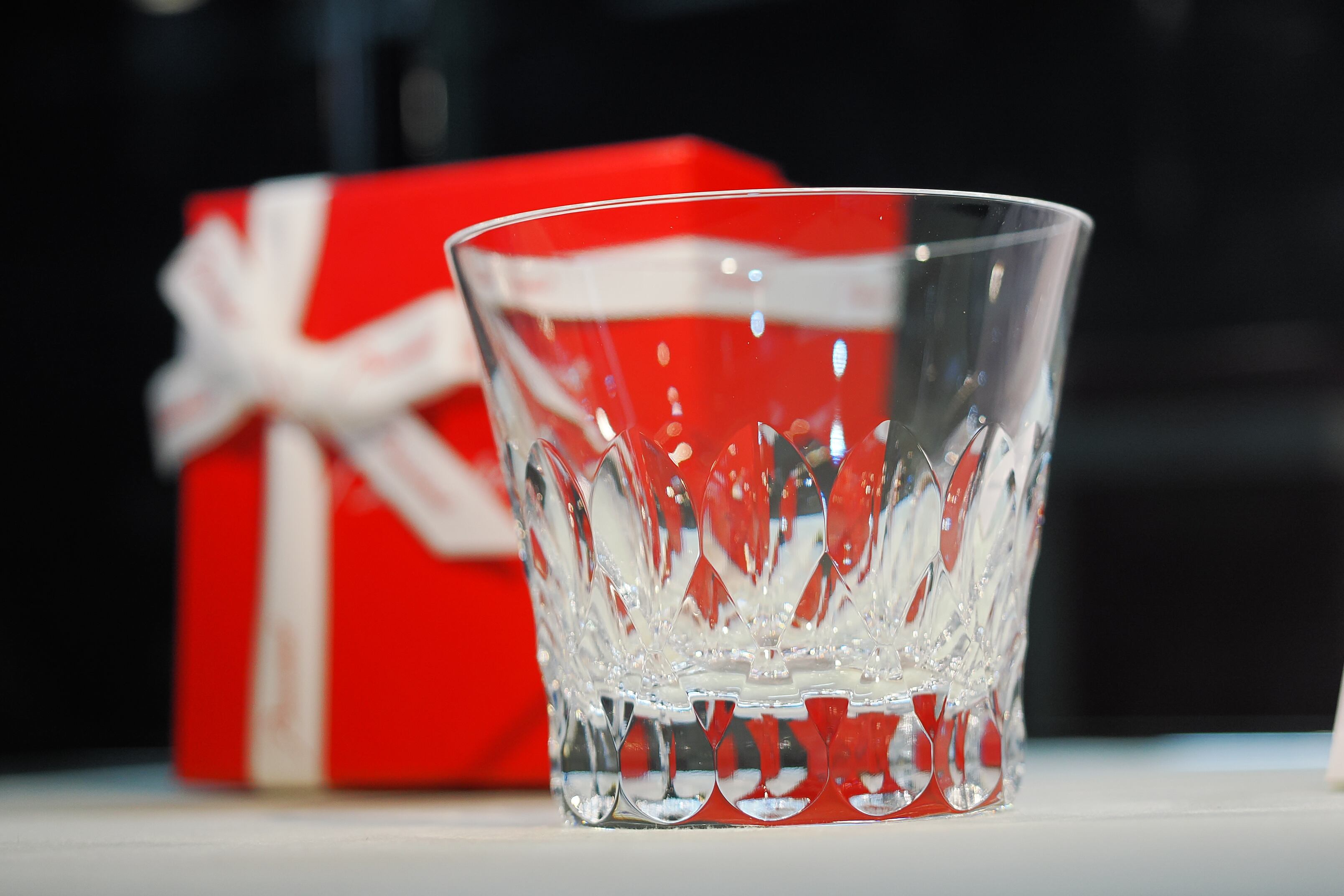
The question I asked myself most while running was, ‘Why do I run?’ Someone who found out that the Nagoya Marathon completion souvenir was a luxury tumbler (Baccarat) worth tens of thousands of won said, ‘That makes sense.’ If it had been for the completion tumbler, I probably would have given up before reaching 20 km.
When I first prepared for the full course, my usual GPS watch predicted a completion time of 5 hours and 20 minutes. Going back further, two years ago when I started running to recover my physical strength, I could not even complete 1 km. Two weeks before the competition, the watch predicted a completion time of 4 hours and 9 minutes. I think I liked the honesty of running, where shortcuts and tricks do not work. I set a target time of 4 hours and 30 minutes, later than the AI (watch) and YouTuber predictions, considering it was my first full course and an overseas marathon. Still, I secretly aimed for a ‘negative split’—running the second half faster than the first—but it was wishful thinking. My body started hurting exactly at a distance I had never practiced. Eventually, at 34 km, my right knee felt like it was breaking, forcing me to stop for about two minutes. I applied pain relief patches all over my legs. I picked up a Nagoya specialty sweet, ‘uiro,’ distributed by volunteers, ate it, and dragged my legs back onto the course. I heard ‘Gambare’ (keep going) and ‘Faito’ (fighting) more times than ever in my life. Final record: 4 hours, 25 minutes, and 18 seconds. I had unknowingly passed through the ‘longest distance of my life.’
- 월 5900원 멤버십, 신문 독자에게는 2900원, 조선멤버십
- 55000원 상당의 신문-잡지 8종 마음껏 보기, 조선멤버십
- 현금처럼 쓸 7000포인트 받아 알뜰한 쇼핑, 조선멤버십
Post a Comment for "Nagoya marathon cheers propel runner past 34km struggle"