
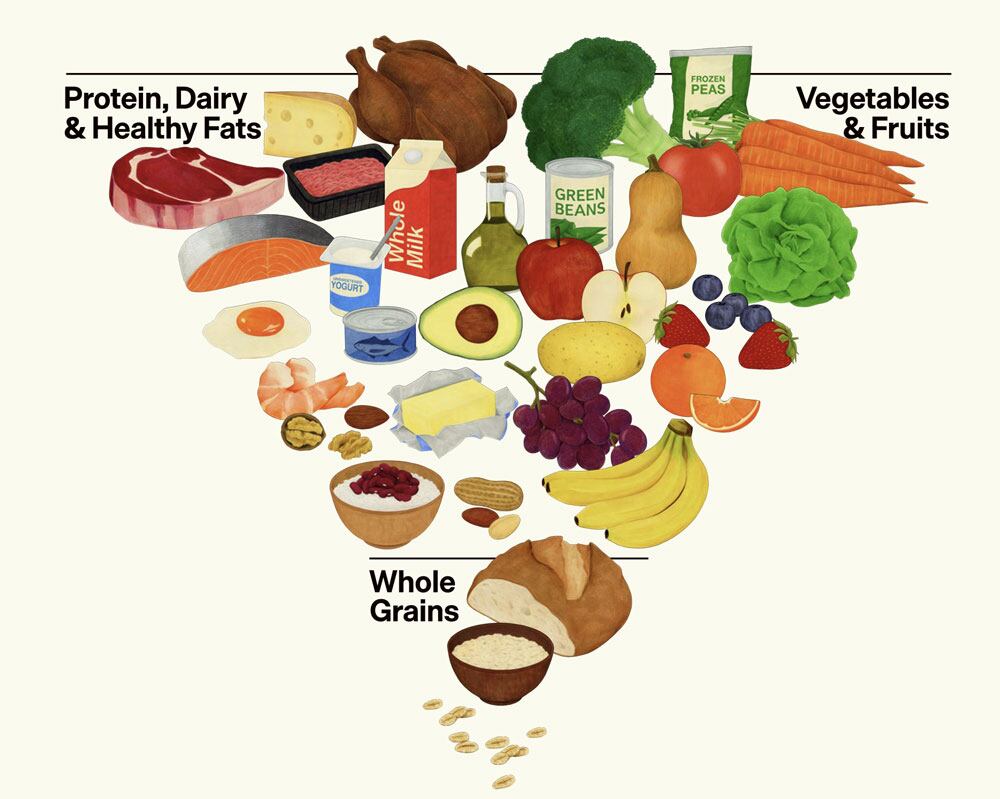
The U.S. government released new dietary guidelines last January. Serving as the foundation of U.S. nutrition policy, which is announced every five years, these guidelines directly impact the diets of Americans, from nationwide school meals to federal nutrition welfare programs and meals for the elderly and disabled. In the newly announced guidelines, the shape catches the eye before the content. The familiar “nutrition pyramid” of decades past has been flipped upside down. Instead of the traditional stable model with a wide base at the bottom and a pointed top, the inverted triangular pyramid itself sparks debate. The flipped pyramid speaks of politics before nutrition. It is a device intended to visually imprint the message, “We have completely changed the game,” all at once.
◇Political Communication That Upended Science
The core slogan of the new guidelines is simple: “Eat real food.” The guidelines prioritize protein, doubling the previous recommended intake. Adults are advised to aim for 1.2–1.6 grams of protein per kilogram of body weight, and whole-fat dairy products are recommended. The inclusion of butter or beef tallow (우지) as alternatives for cooking fat is also groundbreaking.
These guidelines contain contradictions. While the text still states, “Limit saturated fat to within 10% of total calories,” the visuals prominently feature steak and cheese. It is practically impossible to follow the recommended intake of steak and whole-fat dairy while keeping saturated fat consumption within 10% of total calories. The scientific fact that excessive saturated fat raises cholesterol levels and increases cardiovascular disease risk remains unchanged. However, people are drawn to the strong imagery rather than the fine print. In the U.S., fast-food chains have already emerged that fry French fries exclusively in beef tallow.
This approach directly conflicts with recent international scientific recommendations. The EAT-Lancet Commission report, published last year in the international academic journal *The Lancet*, emphasizes limiting red meat consumption to an average of 15 grams per day for the health of humanity and the planet. According to the report, current red meat consumption in North America is already at a severe excess of 700% of the recommended amount. While the scientific community warns that excessive red meat consumption is linked to increased risks of type 2 diabetes, cardiovascular disease, colorectal cancer, and overall mortality, the U.S. government’s new guidelines have instead widened the path to meat consumption.
The recommendation of whole-fat over low-fat dairy is also controversial. Research findings are significantly mixed when it comes to concluding that whole-fat dairy is more beneficial to health than low-fat. The suggestion to prohibit added sugar intake until children reach age 10 is also nearly impossible in practice. Particularly, the claim by Secretary Robert F. Kennedy Jr. that plant-based seed oils are poisoning Americans lacks scientific basis, and there are far more studies indicating that moderate consumption of plant-based oils is associated with health improvements.
◇What the Nutrition Pyramid Misses
The fundamental error of these guidelines lies in the misconception that a single nutrition pyramid exists that works for all generations and all people. Political messages wield simplicity as a weapon to boldly influence the public, but nutrition operates entirely differently depending on an individual’s life cycle and environment. Statistics show that American men on average consume over 100 grams of protein per day. Among South Korean men in their 20s and 30s who vigorously shake protein shakes, many consume this amount, which exceeds the recommended intake by Korean standards. According to the Korean Dietary Reference Intakes presented by the Ministry of Health and Welfare and the Korean Nutrition Society, the recommended protein intake for adults is 0.91 grams per kilogram of body weight.
The group most urgently needing protein is not the youth buying protein drinks, but the elderly over 60, whose muscle growth has slowed due to anabolic resistance. Elderly individuals who reduce meat intake due to digestive issues require more protein, while the youth, who already consume enough, need moderation.
The dichotomous attitude of dividing food into “natural” and “processed” is also dangerous. The slogan “Eat real food” sounds plausible, but leaves too many questions unanswered. What is “real”? Is butter and steak good because they are natural, while tofu and soy milk are bad because they are processed? Is whole wheat bread a source of guilt because it is processed, while beef tallow is a gift from nature? Yogurt, kimchi, and doenjang are all processed products that humanity has developed for safe storage and digestibility. Cutting food with the knife of “natural/processed” leaves not science, but division.
◇An Era of Consuming Symbols Before Nutrition
Viewed through the lens of politics, the meaning of the new guidelines becomes clearer. U.S. nutritionist Marion Nestle has asserted, “Food is political.” The moment a nation dictates what to eat, it reveals its values beyond health metrics. The fact that these guidelines begin by highlighting “American producers” and are connected to the political slogan “Make America Healthy Again” shows that they are a declaration of “who is now mainstream” before they are nutrition science. The inverted pyramid is a political tool used to attack the previous evaluation system, rather than focusing on the details of nutrition.
The moment politics climbs atop food, we consume symbols before nutrition. Brillat-Savarin, a 19th-century French judge and gourmet, left the famous saying, “Tell me what you eat, and I will tell you who you are.” While he sought to read a person’s identity through their food, modern society often evaluates the value of food based on who eats it. In 2014, British media reported Kim Jong-un’s rapid weight gain, analyzing it as due to his “preference for Swiss Emmental cheese.” Here, cheese becomes the culprit of luxury and obesity. Conversely, in 2011, when Kate Middleton, the Duchess of Cambridge, was reported to manage her weight with a high-protein diet, cheese and meat were framed as icons of “elegant restraint.” The meaning of the same food can completely reverse depending on the flow of power and social context.
Therefore, there is no need to hastily overturn one’s diet upon seeing these guidelines from Korea. Political messages are clear and simple, but our bodies are not election battlegrounds. Flipping a pyramid requires just a sheet of paper, but a person’s healthy eating habits are completed over a much longer breath than the cycle of regimes. Before lifting a spoon, we must coldly ask whether, under the pretense of deciding “what to eat,” we are actually asking “who is on our side.”
- 월 5900원 멤버십, 신문 독자에게는 2900원, 조선멤버십
- 55000원 상당의 신문-잡지 8종 마음껏 보기, 조선멤버십
- 현금처럼 쓸 7000포인트 받아 알뜰한 쇼핑, 조선멤버십
Post a Comment for "US dietary guidelines flip pyramid, politics over science"