
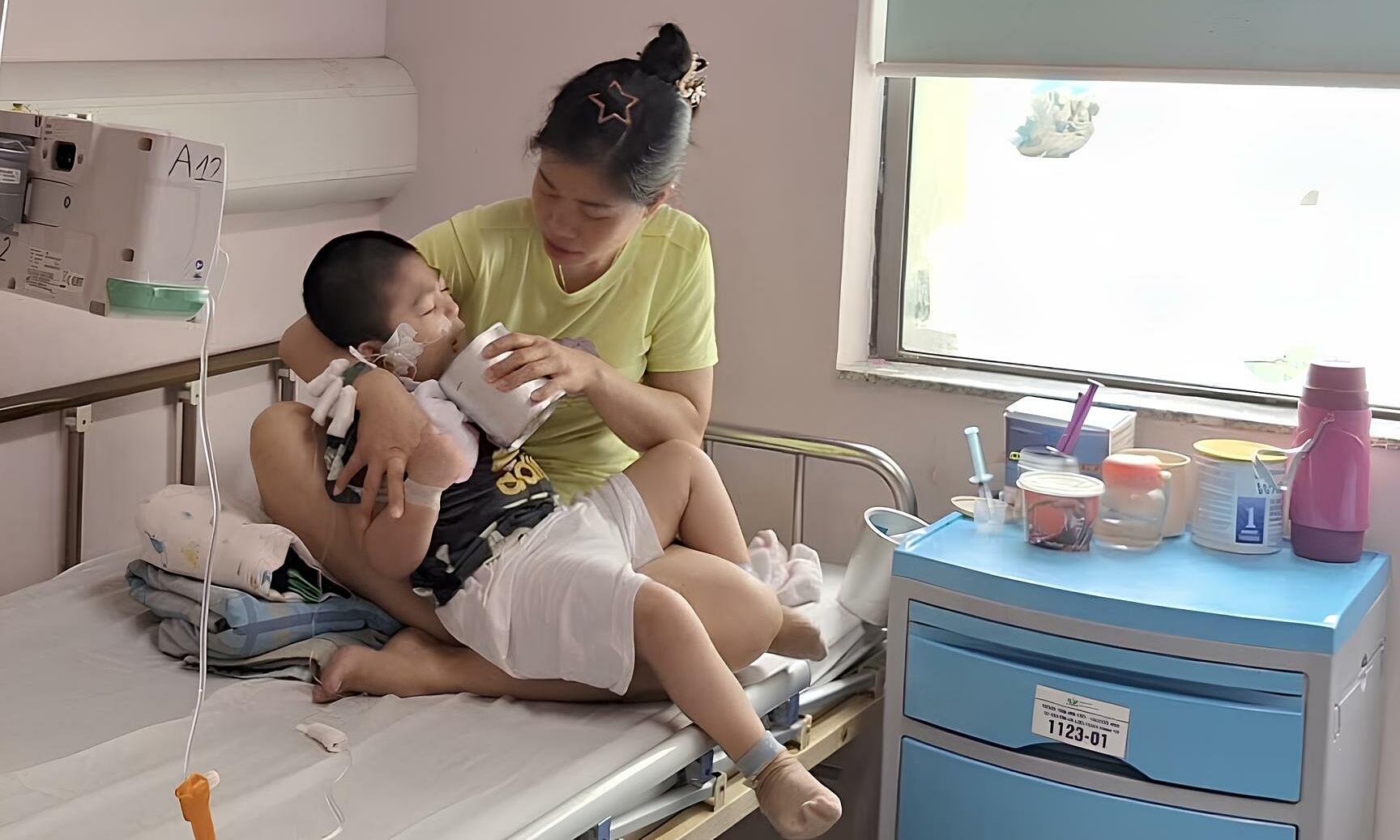
Since he was born with a rare genetic disorder that prevents his body from processing protein, Trinh Ngoc Duong’s daily meals are measured by his mother gram by gram to prevent brain poisoning.
Earlier this month Nguyen Thi Ca, 41, of Thanh Hoa Province brought back her youngest son, Duong, to the National Children’s Hospital in Hanoi with pneumonia.
Over four years old, Duong weighs 19 kg and stands 110 cm tall, but his cognitive level is equivalent to that of a three-month-old.
He relies entirely on a feeding tube for nutrition and requires assistance with every daily activity.
He suffered brain damage at birth via emergency cesarean section at 35 weeks in 2021.
He initially appeared normal, but after eight days began feeding poorly and became lethargic before slipping into a coma and requiring a ventilator.
Initially diagnosed with bronchopneumonia and neonatal infection, his condition did not improve after six days of treatment.
He was transferred to the National Children’s Hospital, where tests revealed his blood ammonia levels were 10 times higher than normal. He had to undergo emergency dialysis.
He was diagnosed with a urea cycle disorder called Citrullinemia type 1. It is a rare metabolic disease that leaves the body unable to tolerate protein. Any protein could lead to the accumulation of toxins, causing brain poisoning and potentially coma or death.
Due to the delay in diagnosis and specialized treatment, he sustained severe brain damage.
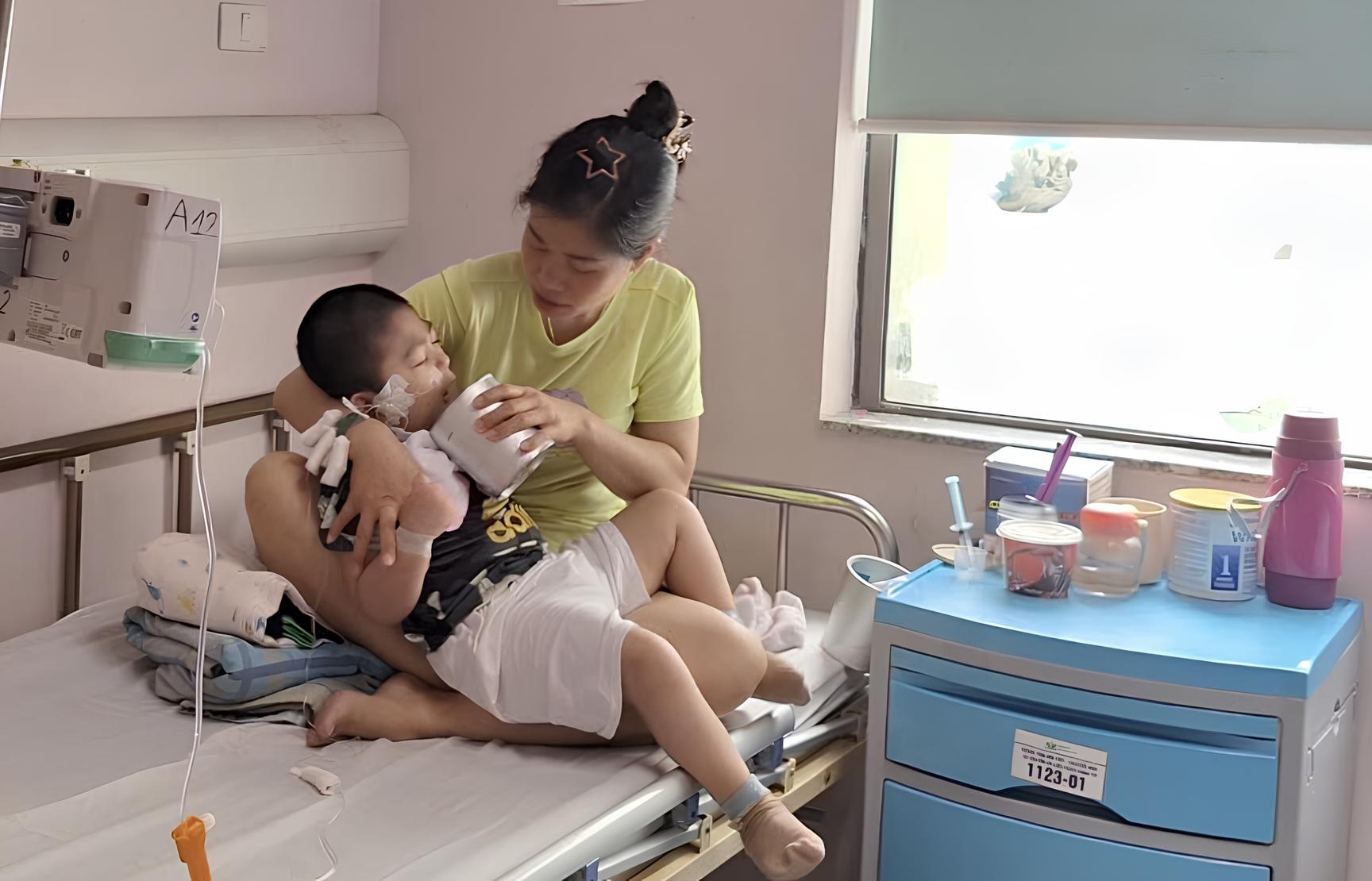 |
| Nguyen Thi Ca holds her son to help him deal with coughing and reflux. Photo by Bao Nhien |
The combination of this rare metabolic disorder and cerebral palsy has made caring for Duong extremely complex.
He frequently experiences muscle spasms and gastroesophageal reflux, leading to recurrent respiratory infections.
Since May 2024, after multiple episodes of septic shock that severely impaired his swallowing reflex, the family has had to feed him exclusively through a gastric tube.
His diet is strictly controlled.
His daily protein intake is limited to a maximum of 25 grams or equivalent to one tablespoon of meat or fish or a single egg white. In addition to specialized formula, his mother uses a precision scale to measure every portion of food. She completely avoids high-protein vegetables such as beans, spinach, water spinach, and amaranth because their protein content is difficult to calculate precisely.
She says: "Food intake is just one variable. Constant monitoring is essential because my son easily chokes, has weak breathing and his condition can deteriorate at any moment."
Her greatest fear is the emergency dash to the hospital in Hanoi in the middle of the night, a trip that takes more than three hours.
On one occasion she rushed him to the emergency room at 1 a.m with his face turning blue. Doctors told her to complete the admission procedures, but, being alone, she had to ask a nurse to watch over her child.
"I ran like lightning to pay the fees. When I returned, my son, who could not see me, became so tense that the newly inserted IV line was ruined."
She has repeatedly pulled him back from the brink of death, especially during two severe septic shock episodes in September 2024 and April 2025.
In the intensive care unit, he was on the verge of multiple organ failure. Doctors once advised the family to prepare for the worst, but she insisted on continuing with his treatment.
He came off the ventilator a week later.
After hospital stays lasting 30-40 days, seeing her growing increasingly weak, doctors suggested she should ask for family support.
She could only offer a strained smile: "There’s no one else at home. I can manage."
She cannot ask her husband for help. At home, Trinh Van De, 42, shoulders the family’s financial burden entirely while also caring for their two older children.
The monthly expenses for Duong’s specialized formula, endocrine and neurological medications come to VND8 - 10 million (US$304-380).
The milk and medicines must be ordered from the U.S. through rare-disease-support groups, with the formula alone costing around VND3.5 million a month.
Hospital stays increase the costs a great deal.
During prolonged treatments, the family relies on assistance from the hospital’s social work department and borrows money from every possible source.
The heavy workload has caused De to develop macular retinopathy, putting him at risk of blindness if stress continues.
The couple face yet another challenge: Their second child, 10-year-old Hanh Nhu, has been diagnosed with combined tic disorder and attention deficit hyperactivity disorder.
She experiences involuntary muscle spasms and speech outbursts, apparently partly because of the prolonged lack of parental attention since the couple focus on treating their youngest child.
Her medication is frequently interrupted due to the family’s financial prioritization of Duong’s treatment.
While caring for him in hospital, there are days when Ca must hold him in her arms for up to 20 hours to prevent vomiting and reflux.
Despite the unspeakable hardships, she continues to care for and love her son as if each day might be his last.
She says simply: "He came into our lives as a destiny. As long as he lives, my husband and I will give him our all."
Supporting children with rare diseases and difficult circumstances is part of the "Sun of Hope" program run by the Hope Foundation. Every contribution from the community brings another ray of light to the future generations of the country. Readers can join the program here.
Post a Comment for "Battle to keep alive a child from killer protein dose"