
- Click here to visit the Scotland home page for the latest news and sport
Flu cases in Scotland have soared by 45 per cent in just a week amid warning the NHS is facing ‘collapse’ under the pressure.
GP surgeries and hospitals are being flooded with patients of all ages amid fears vaccines are not as effective with a new strain of the virus circulating.
According to the latest figures from Public Health Scotland (PHS), during two weeks last month there were 13 deaths linked to flu, of which five listed it as the main underlying cause on their death certificate. Four of these were aged 75 and over, while one was under 44.
Health Secretary Neil Gray was warned last month of the looming crisis with critics blasting him for doing ‘too little too late’.
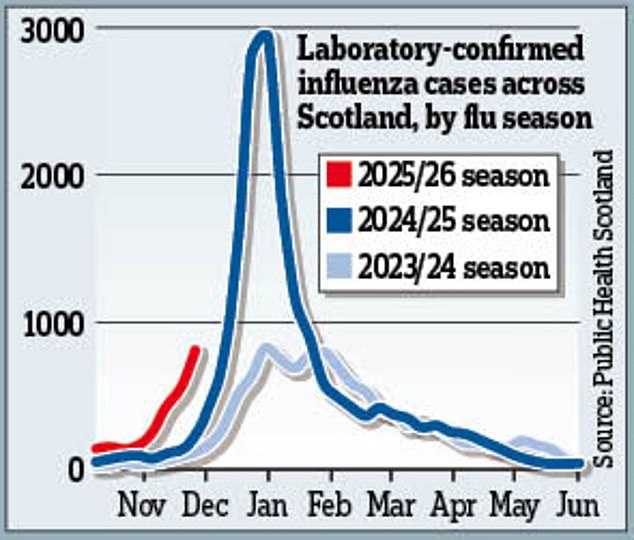
Now GPs are seeing an ‘unusually early flu surge across the health system’ with official data showing the number of laboratory-confirmed cases north of the Border soared from 555 to 805 in the week ending November 23 - a level not normally seen at this time of year
Hospital admissions also rose over the same week adding to pressures on the ‘already overwhelmed’ NHS, with the overall incidence rate increasing from 10 to 14.5 per 100,000 people.
Scottish Conservative shadow health secretary Dr Sandesh Gulhane claimed Mr Gray’s winter plan was ‘not worth the paper it is written on’.
He said: ‘As a GP, I am seeing first-hand how many patients have been turning up with flu before we get into the proper depths of winter.


‘The SNP health secretary has completely failed to support frontline services for the months ahead and his winter plan isn’t worth the paper it is written on.
‘Unless Neil Gray gets a grip then patients lives will be put at risk from the effects of flu and our health service will collapse this winter.’
NHS Dumfries and Galloway had the highest incidence rate at 24 cases per 100,000 people, closely followed by NHS Greater Glasgow and Clyde at 22.3 and NHS Ayrshire and Arran at 19.3 per 100,000.
Greater Glasgow - the country’s biggest health board - where there were 272 cases during the week ending November 23 - is now urging the public to stay away from healthcare settings if their symptoms are not severe.
A spokesman said: ‘Visiting GP practices, A&E, or hospital wards with mild or moderate flu symptoms risks spreading the virus to vulnerable patients who may already be admitted or awaiting care. This can lead to further outbreaks and increased strain on services.’
Dr Chris Provan, Chairman of the Royal College of GPs in Scotland (RCGP), said: ‘In my own practice, there has been a marked increase in patients presenting with respiratory symptoms, which reflects the national data.
‘Figures from the RCGP’s Research and Surveillance Centre show that rates of influenza-like illness in general practice remain well above the seasonal average and continue to rise across most regions and age groups.
‘For many people, winter illnesses will resolve with rest, fluids and over-the-counter remedies. However, for others - particularly older people, babies and young children, pregnant women and those with chronic conditions - the risk of serious complications requiring hospital care is much higher.’
He added: ‘There have been reports that the flu vaccine may be less effective against this strain but it still offers important protection and can reduce the severity of illness, helping to prevent hospitalisation.’
Eileen McKenna, Associate Director, Nursing, Policy and Professional Practice, Royal College of Nursing said: ‘Nursing staff are doing their best for patients but are worried about what coming weeks and months will bring, given the already challenging circumstances and another very difficult flu season being predicted.
‘Hospital overcrowding is not just an inconvenience - it puts patient safety and dignity at serious risk. Flu outbreaks make an already challenging situation even worse.
‘Vaccination is one of the most effective tools we have to reduce the impact of this virus.’
The UK Health Security Agency (UKHSA said early evidence from shows that this year’s vaccine ‘does a good job preventing severe disease, as measured by hospital admissions due to flu for the strains currently circulating in the UK’ with children around 70 to 75 per cent less likely to attend or be admitted to hospital with flu if vaccinated, and adults are around 30-40 per cent less likely to attend or be admitted.
It added that flu vaccine effectiveness against severe disease varies from season to season but is typically between 30 to 60 per cent, with higher vaccine effectiveness typically seen in younger age groups.
Scottish Labour health spokesman Jackie Baillie, said: ‘There are 400,000 fewer adults vaccinated now than there were this time two years ago, while children’s vaccination rates are down and some areas have not even started vaccinations yet.
‘These latest statistics on influenza levels is a stark reminder of the need to get our health service back to where it needs to be, and the importance of having a truly substantive plan for recovery in place.
‘We also know that going into winter, these pressures will only be even more difficult to get on top of.’
Scottish Liberal Democrat Leader and health spokesman Alex Cole-Hamilton said the ‘worrying spike’ risks ‘intensifying the winter pressures on our NHS’.
He added: ‘Investment in preventative healthcare can really help to keep cases of flu down, but the SNP are forever on the back foot.
‘Patients and staff deserve better.’
The Scottish Government was approached for comment.
Read more- What's causing Scotland's hospitals to face a daunting crisis amidst an alarming spike in flu admissions this season?
- Will Scotland's overwhelmed hospitals survive the winter as flu admissions skyrocket to unprecedented levels?
- How has the relentless wave of flu overwhelmed Scottish hospitals with an astounding surge in emergency admissions?
- Have UK hospitals reached a breaking point amid skyrocketing flu cases this winter?
- UK hospitals on the brink: Has the flu surge created the busiest winter emergency services have ever faced?
Post a Comment for "Flu cases surge by 45 per cent as mutant strain spreads across Scotland"