
A trio of supplements can reverse autism in mice, according to a new study – and it could prove effective in humans, too.
Researchers have discovered a 'cocktail' of ingredients that boosts communication between neurons in the brain and improves social behaviours.
The results could mark a turning point in efforts to manage the condition, for which there is currently no cure.
'These findings have revealed a promising new avenue for dietary therapy in the treatment of autism spectrum disorder (ASD),' the team wrote in the journal Plos Biology.
Autism, which results from the abnormal development of neurons in the brain, affects approximately one in every 100 children in the UK.
Autistic people can find it hard to communicate and interact with others and struggle to understand how other people think or feel.
They may also find bright lights or loud noises overwhelming and get anxious about unfamiliar situations.
'I was thrilled to observe that just seven days of treatment with the nutrient mixture significantly modulated neuronal circuit activity and connectivity in real time,' Ming–Hui Lin, the study's co–first author, said.
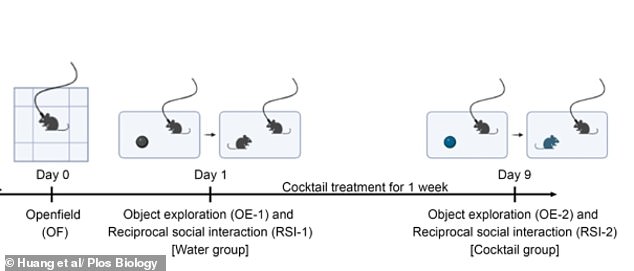

For their study, scientists from the Academia Sinica research institute in Taiwan focused on three ingredients – zinc, serine and branch–chain amino acids (BCAAs).
Zinc is essential for brain function and plays a crucial role in the connectivity between neurons in the brain.
Serine is a type of amino acid that is important for neurotransmission, while BCAAs help regulate the balance of signals in the brain.
The team hypothesised that a mixture of the three would be a more effective treatment than any individually and tested their theory in autistic mice.
Analysis revealed the cocktail of supplements altered their brains, calming the activity of neurons and improving their overall social behaviour.
However, when each supplement was given separately, the same dosages had no effect on behaviour.
'Our findings show that a low–dose nutrient mixture containing zinc, branched–chain amino acids and serine—offers a safe and more practical strategy for long–term, broad application, even beginning in childhood,' Yi–Ping Hsueh, one of the study's authors said.
While there is currently no current medicine that directly treats autism itself, certain medications can help manage challenges such as anxiety, impulsivity and sleep difficulties. Non–medical approaches include cognitive behavioural therapy, speech and language therapy, diet and nutrition support and social skills training.
A recent study suggested that taking a common supplement for 12 weeks was found to reverse some autism symptoms.
A daily probiotic made from healthy bacteria may reduce hyperactivity in young children, Spanish scientists said.
Their probiotic contained bacteria known to boost the production of two key brain chemicals involved in calming movement and regulating attention.
Researchers conducted the trial on 80 children between ages five to 16, out of which 38 were diagnosed with ADHD and 42 with autism.
The study found out that the children who took the supplement every day showed greater improvements in hyperactivity scores than those who received a placebo.
Children with autism who took probiotics reported greater physical comfort, including fewer aches, more energy, and reduced stomach issues, compared to baseline, with a large effect size.
Scientists have also uncovered evidence that dogs can be neurodiverse in the same way as their owners.
Dr Jacqueline Boyd, an animal scientist from Nottingham Trent University, said our faithful companions can have similar structural and chemical differences in their brains to those found in humans.
This means dogs can show symptoms that would be diagnosed as autism and attention deficit hyperactivity disorder (ADHD) in humans.
Currently, there is no formal diagnosis for autism or ADHD in dogs, and vets group this behaviour under the broad umbrella of 'Canine Dysfunctional Behaviour' (CDB).
However, Dr Boyd says that scientists are now starting to give serious attention to the idea that animals might experience the world differently because of diversity in how their brains function.
'Some dogs might be very much like the neurotypical human, whereas other dogs might be more neurodivergent and be more like someone with autism or ADHD,' she told the Daily Mail.
Read more- Is the key to easing autism symptoms lurking in your cheese? Discover how a probiotic transformed autistic behavior in mice.
- Could CBD be the magic bullet for autism symptoms? Promising new study unveils groundbreaking improvements in children's social skills and behaviors!
- Is the psychedelic LSD a surprising key to improving autism symptoms? Study unveils dramatic effects on canine brain synchronization!
- Could everyday probiotics be the surprising answer to easing hyperactivity in children with autism and ADHD?
- Attention dog owners: Could your beloved pet's behavior resemble ADHD or autism? Learn what experts are revealing about neurodivergent dogs!
Post a Comment for "Scientists unveil supplement trio that REVERSES autism in mice - and say it could work in humans too"