
A young woman claims that she could end up homeless because she sweats so much that it is impossible for her to get a job.
Unemployed Freya Baker, 25, suffers from hyperhidrosis - a condition which causes people to sweat excessively all year round - and says the embarrassment has left her housebound.
She said: 'I am put off applying for jobs because I think they are not going to want me looking really sweaty.
'People don't realise that it can completely impact your life to the point where you don't have a quality of life.
'I don't know where everyone gets the idea that being on benefits we live this luxury lifestyle. I am on no income whatsoever and what I get from my benefits doesn't even cover rent.
'I am going to end up without anywhere to live at the rate this is going.'
Ms Baker, from Sittingbourne, Kent, previously worked at a supermarket but mainly had to work night shifts so that there were no customers around to see her.
'It is not temperature based, so it can be freezing cold and I will still be excessively sweating from my underarms,' she said.
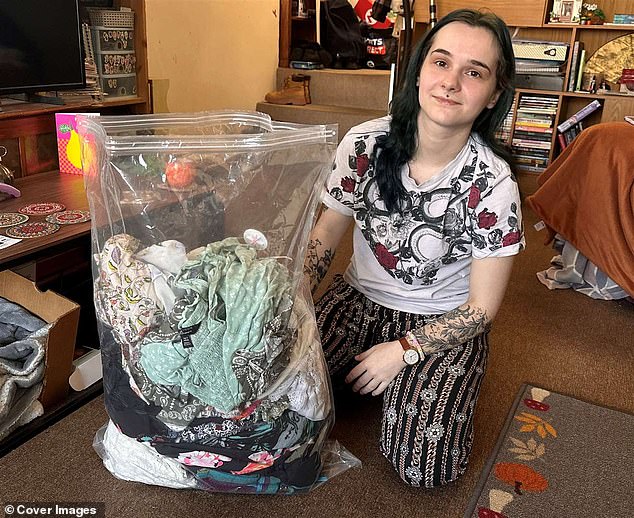
'It is constant. I can't wear a shirt for more than five minutes if that. I wouldn't even attempt to wear white now because I don't want it to get stained.
'I am constantly uncomfortable. I don't wear dresses or anything like that, I wear big baggy shirts because I need to be able to wear other clothes under my arms to catch the sweat.'
Ms Baker says that she started experiencing symptoms in 2019 after she was prescribed an antidepressant called sertraline to treat anxiety and borderline personality disorder (BPD).
She says that she was unaware that the sweating was a side effect and stopped taking the medication, but the problem never disappeared.
Hyperhidrosis affect the face, armpits, groin, palms of the hands and soles of the feet, but Ms Baker says that for her, her underarms are the problem area.
And not only does she need to deal with the uncomfortable sensation, she has to cope with painful rashes from where she is constantly wiping sweat away.
Ms Baker has no choice but to wear baggy t-shirts with old clothes tucked under her armpits, which has dented her confidence further.
'Even if I know that I am clean and that I shower constantly it doesn't make a difference. I still get self-conscious about it. I can't leave the house,' she said.
Furthermore, she is fed up.
It took Ms Baker years of 'fighting with her GP' to get a diagnosis of hyperhidrosis, but it took several more to get a dermatologist to recommend her for treatment.
Originally she was put on tablets called propantheline, but she claims that they caused unpleasant side effects, such as dehydration, and didn't seem to help.
Now, she has finally been granted NHS funding for Botox, which costs around £400 per session, which that should temporarily block the nerves that stimulate sweat glands.

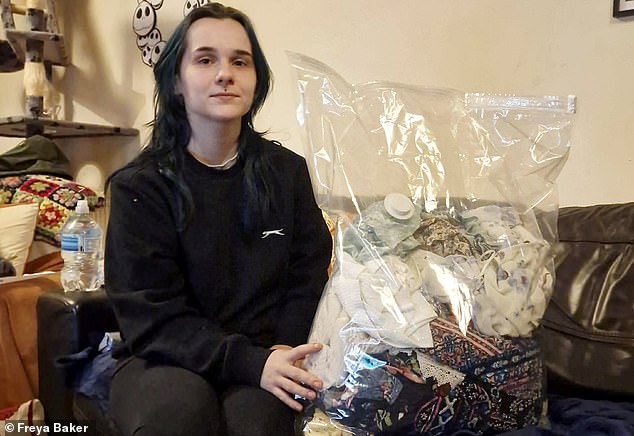
However, since this was approved in February, she says that she has received no news on when the 'life-changing' treatment will start, and how many sessions are covered.
She added: 'They just don't give you any information. I am tired of asking the same questions because no one is answering them anyway.
'It would be a serious game changer. If I got the treatment that I needed then I wouldn't have to spend my entire 20s miserable. They have taken my 20s from me with this.
'Something needs to be done about people waiting years. It took me multiple years to get a diagnosis because they would just ignore me.'
Ms Baker is now trying to raise awareness on the condition and is pushing for it to be considered as a disability.
She said: 'I have had dozens of messages now from people saying that they are in the exact same situation as me.
'Why should we have to be ashamed and hide in our houses and be attacked on the internet when I say that I am struggling to go to work. We are made fun of and it is not alright.
'It is a common problem and yet nobody talks about it. We are all hiding it because we are embarrassed by it. We shouldn't keep suffering quietly.'
While hyperhidrosis is generally under-discussed issue because of the embarrassment it causes, estimates suggest it affects around 1 per cent of the UK population – around 670,000 people. And for some, it can be a significant problem.
Dr Adil Sheraz, from the British Association of Dermatologists (BAD), previously told the Daily Mail: ‘The impact on patients can be terrible. I’ve seen teenagers struggling to hold a pen or write on paper because it gets wet. I’ve had patients prevented from joining the Army because their hands were too slippery to hold weapons.
‘Patients who constantly sweat often have to change several times a day and take two or three shirts to work. It affects their mental health and means they avoid socialising or taking part in exercise. It can seem like something that isn’t taken very seriously, but people do genuinely suffer.’
According to BAD, it often begins in childhood or adolescence and often improves or disappears with age.
While certain medications or health conditions are linked to excess sweating - such as viral infections, menopause, diabetes or an overactive thyroid - there is no clear cause for hyperhidrosis, and it is more often seen in people with a family history of it.
Common signs include visibly wet skin, clammy palms and soaked clothing, which can interfere with daily tasks and confidence, although the condition itself does not directly cause body odour as it does not affect the sweat glands associated with body odour.
Diagnosis is typically based on symptoms, with tests sometimes used to rule out other conditions.
While there is no simple cure, hyperhidrosis can be managed effectively with treatments ranging from clinical-strength antiperspirants to specialist care, with surgery rarely recommended due to potential side effects.
Read more
Post a Comment for "Woman, 25, claims excess sweating has left her relying on benefits until NHS funds armpit Botox"